
The Pivot
Once you accept that the Accelerator must go, the next critical architectural decision is defining where you are going. In the decoupled universe, the frontend becomes an independent, lightweight consumer of your core backend APIs.
The Architectural Landscape
When we design future-ready storefronts today, we typically look at three major paths:
- SAP Composable Storefront (Spartacus): Built natively on Angular, this is the gold standard for deep integration. It aligns seamlessly with Omni Commerce Connect (OCC) APIs out of the box and natively respects your SmartEdit configurations, saving massive upstream implementation cycles.
- React-Based Storefronts (Next.js / Remix): Highly favored by teams with massive frontend developer ecosystems who want to leverage massive community libraries and excellent Server-Side Rendering (SSR) paradigms.
- Vue-Based Frameworks (Nuxt / Alokai): Celebrated for their exceptional developer experience and ultra-lightweight performance footprints.
The Problem: The "Modernization Tax"
No matter which ecosystem you select, the architectural reality of a migration remains unchanged. Traditional migration forces your engineering team into a grueling, manual forensic exercise.
- Converting legacy .jsp templates and tag libraries to Angular/react components
- OCC Gap Analysis to identify new custom OCC endpoints which need to be developed
- CMS Component mapping
- Migrating custom functionality
Teams must open old .jsp files, trace how custom Spring controllers talk to backend facades, figure out how that data maps to an OCC API, and rewrite it entirely into modern TypeScript, components, and state management.
 Facebook
 X
X
 Linkedin
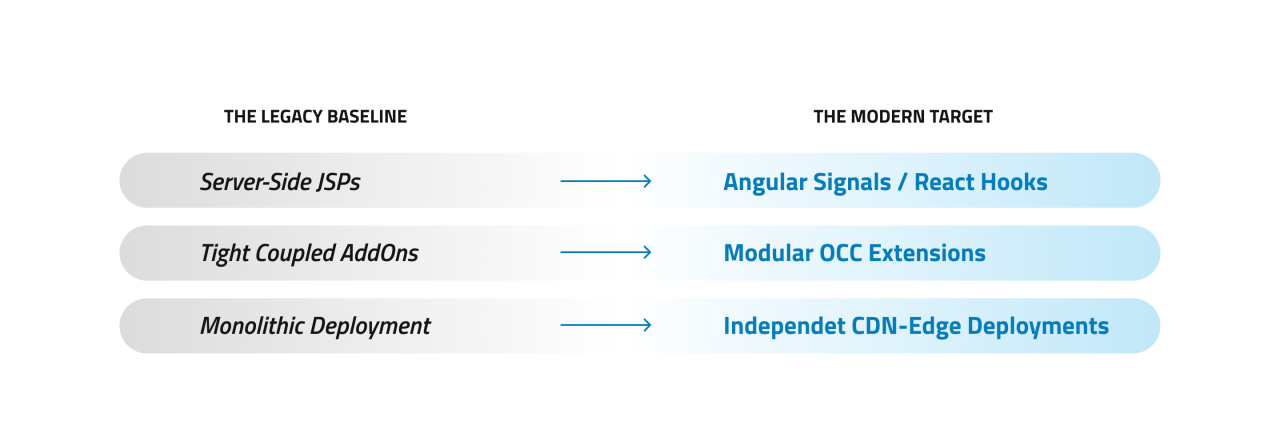
This manual translation loop is where projects stall, budgets blow out, and human error introduces regression bugs. It’s a repetitive, pattern-matching challenge that drains the creative energy of your best developers.
We looked at this problem and asked a fundamental question: Why are we forcing human engineers to act like compilers? In Part 3, I’ll share how we solved this at VASS by changing the entire paradigm of how software engineering works.
