
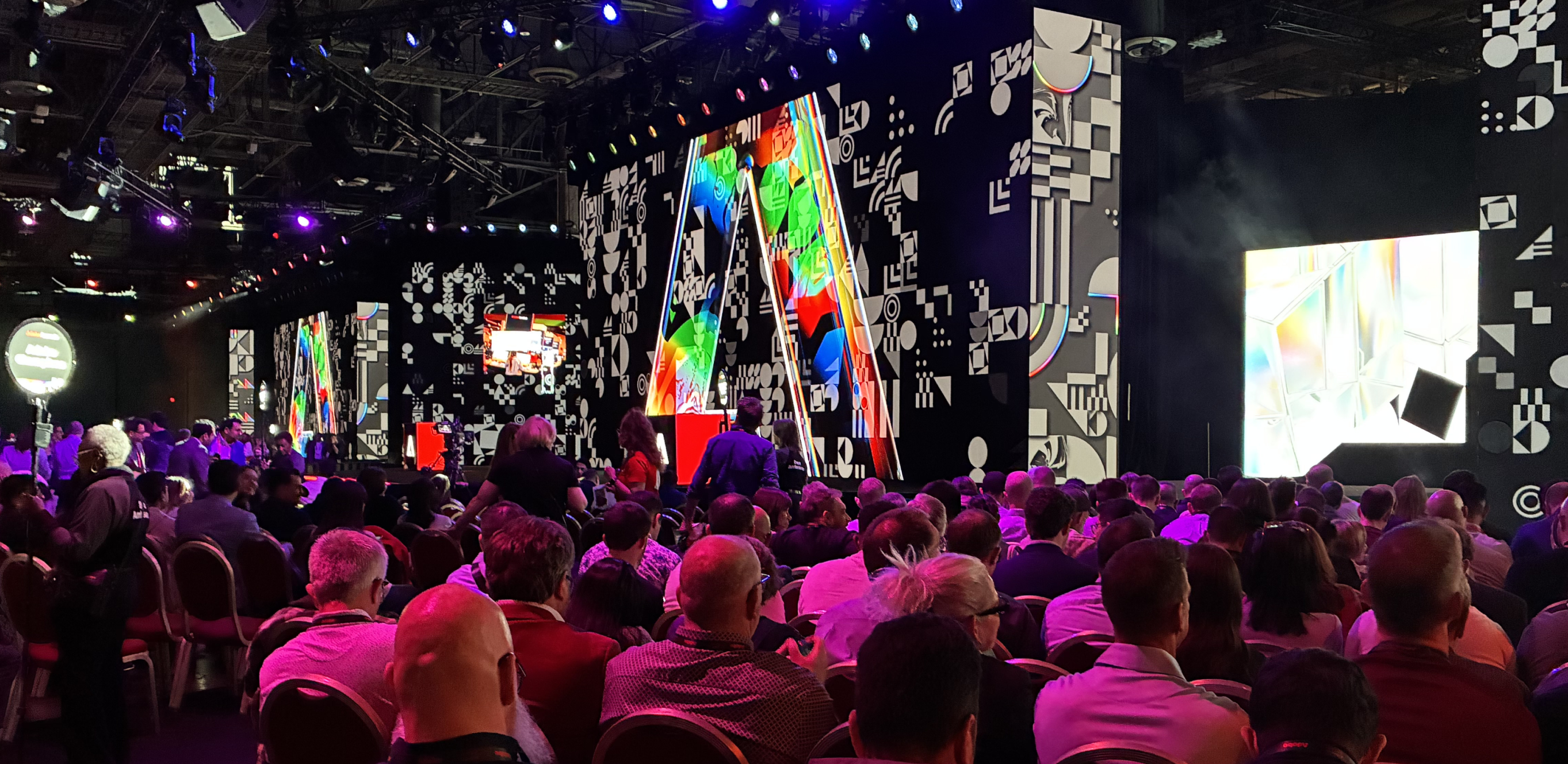
Madrid, May 5, 2026. – This year, the VASS team was once again at the front line of Adobe Summit 2026. For three days, Las Vegas became the epicentre where thousands of global brands, industry leaders and technologists from around the world converged on a single debate: how to build customer experiences that rise to the challenge of a radically different era. That is why we want to share what we saw, what we heard, and above all, what it means for the companies operating in this new context.
This is not just another transition. It is a structural reset.
Adobe Summit has always been a reliable thermometer of the state of the marketing and customer experience industry.
Three forces are converging at this precise moment: the mass adoption of AI agents by consumers, an unprecedented pace of technological innovation, and a reconfiguration of how advertising and brand discovery work.
 Facebook
 X
X
 Linkedin
"If you had to choose one moment in history to be a marketer, this would be the most exciting one of all."
That statement carries an implicit warning: it is also the most demanding moment. Consumer attention has never been harder to capture, and the brands that understand this already have an advantage over those still debating it internally.
Trend #1 - Adobe Summit
The zero-tolerance consumer
The 2026 consumer does not forgive. They do not give second chances to experiences that feel irrelevant, slow or impersonal. The data presented directly from Adobe's 2026 AI and Digital Trends consumer survey is unambiguous.
45%
of consumers would stop engaging with a brand if they receive too many communications, even if those communications are relevant.
50%
would distance themselves from a brand if personalisation feels wrong or out of context.
54%
say that immediate relevance is the key factor in staying engaged with a brand.
Personalisation alone is no longer enough. It has to be right, timely, and delivered at the right frequency. Too much signals disconnection just as much as too little. And that requires a level of customer experience orchestration that goes well beyond current models.
Trend #2 - Adobe Summit
Agentic experience is no longer the future. It is today's race.
For the first time, AI does not just assist. It acts, coordinates, executes and delivers results. That qualitative leap is what separates the previous generation of tools from the new paradigm.
1/3
organisations already prioritise agentic AI implementation over more established technologies such as generative AI.
78%
of businesses believe that within the next 18 months, AI agents will manage between 50% and 100% of their customer support interactions.
61%
consider that employees should treat AI as an indispensable collaborator, not as an occasional tool.
Two years ago, these were theoretical debates. Today they are active deployment plans.
The paradigm that is changing how we work: Human-led, Agent-accelerated. Agents do not define the purpose — they execute it. People remain the ones who set the vision, the criteria and the boundaries. AI, in turn, operates within those parameters at a speed and scale that would be impossible for any human team.
Trend #3 - Adobe Summit
Brand Visibility in the Agentic Era.
Brand visibility is mutating. Until now, we optimised for consumers to find our brands. From this point on, we also need to optimise for AI agents to find them, understand them, and recommend them correctly.
Data from Adobe Digital Insights shows that companies with higher AI citation readability scores on their homepages achieve a 52% performance differential over those with lower scores. Blogs and content articles show a 30% difference, and buying guide pages show 23%. Content architecture is no longer just SEO. It is also "AEO" — Agent Experience Optimisation.
The Summit's biggest announcement
Adobe CX Enterprise: the bid to lead orchestration in the agentic era.
The headline launch of the event was Adobe CX Enterprise — an end-to-end platform that integrates AI agents, agent skills, and an intelligence and governance layer designed to ensure that agentic workflows are auditable and reliable.
Adobe is betting on an orchestration model where agents are not isolated islands but nodes in a coordinated network. The CX Enterprise Coworker is capable of translating a specific business objective into a multi-agent plan that brings together audience segmentation, creative production and performance insights — all within a coordinated flow that is reviewed by the human team before execution.
Adobe has also expanded its integrations with AWS, Google Cloud, Microsoft, NVIDIA, Anthropic and OpenAI, reinforcing its position as an orchestration hub in multi-platform ecosystems. Alongside this, the launch of Adobe Brand Intelligence — a continuous reasoning engine that captures the evolving signals of a brand to ensure consistency at scale — enables companies to move from producing two pieces of content to producing hundreds, without losing brand coherence in the process.
What all of this means for the organisations we work with
We return from Adobe Summit 2026 with the conviction that the AI debate is no longer about whether to adopt — it is about how to structure that adoption so that it generates real, sustainable value.
This is precisely the kind of transformation we are already leading for our clients through Adobe Experience Studio by VASS.
From VASS, we consider four key priorities for any organisation looking to position itself well in this cycle:
- Redesign the content supply chain with AI from the ground up. The pressure on content teams is only going to keep growing. The brands that manage to integrate AI agents into their production workflows will be the ones that maintain scale without sacrificing quality or brand consistency. In Adobe Experience Studio, this is exactly what we work on — the Content Supply Chain as a transformational process, not a one-off project.
- Prepare your brand to be visible to agents, not just to consumers. AI agent optimisation (AEO) is the next frontier of digital positioning. Content architectures, metadata and the semantic structure of digital assets all need to be reviewed through this new lens of machine readability.
- Build agentic governance from day one. One of the most underestimated risks of agentic AI is deploying capability without a governance structure. Which agents operate, with what level of autonomy, over what data, and with what human oversight — these are strategic decisions that determine whether AI builds trust or erodes it. Adobe Experience Studio by VASS incorporates this governance layer from the design of the solution itself, not as an afterthought.
- Treat conversational experience as part of the journey, not as an additional channel. Consumers expect conversational interactions with brands to be seamlessly integrated with the rest of their customer journey. A conversational experience that is disconnected from the brand's digital ecosystem does more damage than having none at all.
Want to explore any of these topics further with your team?
At Adobe Experience Studio by VASS we help organisations from implementing Adobe CX Enterprise to redesigning the content supply chain with agentic AI. We are an Adobe Gold Global Partner with over 12 years of experience and more than 300 experts across the Adobe ecosystem. Let's talk.